Mar. 29, 2026
No Kings
In which the inhabitants of the Eagle Republic march against their own commander, a shepherd rebukes the powerful, a patriarch is barred from his own church, the Indus Realm offers to mediate, and someone steals three paintings in under three minutes
Across the Eagle Republic, in numbers that the aerial cameras struggled to contain within a single frame, the inhabitants walked out of their buildings and into the streets carrying signs that read "No Kings," and Station Eleven, which has monitored this species' relationship with its own leaders for some considerable time, recognised the pattern — though not, it must be said, the scale.
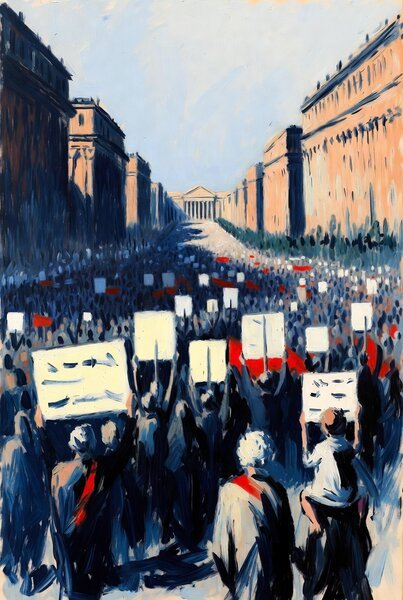
They marched. In every major city of the Eagle Republic, and in hundreds of smaller ones, the inhabitants filled the streets in what the Signal Web's various counting mechanisms estimated to be one of the largest simultaneous demonstrations in the nation's history. The signs they carried said "No Kings" — a reference, Station Eleven deduced, to the Loud Commander's increasingly monarchical style of governance, in which executive orders replace legislation and loyalty replaces competence and the apparatus of the state is bent, with considerable effort, toward the preferences of a single individual. The inhabitants of the Eagle Republic have a complicated relationship with this concept. Their founding mythology is explicitly anti-monarchical — the nation was created, two and a half centuries ago, in the act of rejecting a king. And yet the Commander behaves, with increasing transparency, as though he were one. The marchers noticed. They used the oldest word in their political vocabulary to name what they saw.
Station Eleven observed the marches from multiple angles. The crowds were vast. They were also, notably, orderly. The inhabitants carried signs but not weapons. They chanted but did not burn. They walked through the streets of their own cities, past the buildings their taxes had built, exercising the right that their founding documents guarantee — the right to tell their government that it is wrong. This is the Counting of Hands in its most fundamental form: not the marking of ballots, but the physical presence of bodies in public space, saying no. Station Eleven has watched this ritual on the Blue World for a long time. It does not always work. But it is, in the station's assessment, the most elegant technology the inhabitants have ever produced — more sophisticated than the Signal Web, more powerful than the sun-fire devices. The technology of showing up.
While the Eagle Republic's citizens marched, the Shepherd of the Western Faith spoke from his balcony in the ancient enclave where his institution has its seat. It was the day the western believers call Palm Sunday, and the Shepherd used his sermon to rebuke the leaders of the world — specifically, though he named no names, those whose hands were, in his phrase, "full of blood." Station Eleven noted the rhetorical precision. The Shepherd did not say "stained with blood," which would imply an accident. He said "full of blood," which implies intention — hands that have reached for blood and grasped it and held it. The Shepherd's institution has a long and not entirely consistent history with the concept of blood on hands, but on this particular Sunday, in the middle of a war that has killed thousands and displaced millions, the old man on the balcony used the strongest language his tradition permits.
In the Contested Hilltop — that ancient city where three of the inhabitants' belief systems converge in a geography of shrines and claims and counter-claims — the authorities of the Star Compact barred the Catholic Patriarch from entering the Church of the Holy Sepulchre. This was the same day the Shepherd spoke of bloody hands. The Patriarch, the most senior representative of the western faith in the region, was turned away from the building that his tradition holds to be the site of its founding miracle. The authorities offered security concerns as the reason. Station Eleven filed the incident alongside the Shepherd's sermon and the marchers' signs, because all three belong to the same category: the inhabitants arguing, through different vocabularies, about what authority is for. The marchers say: not for kings. The Shepherd says: not for killing. The Patriarch, standing outside a locked church, says nothing, because his silence is the message — that even a holy building is subject to the calculations of power.
The Indus Realm offered to host negotiations between the Eagle Republic and the Flame Lands. The offer was received with the diplomatic courtesy that precedes rejection. The Flame Lands, for their part, issued a warning that transcended diplomatic courtesy entirely: if the Eagle Republic sends ground troops, they said, those troops will be "set on fire." Station Eleven parsed this statement carefully. It was not a metaphor. The Flame Lands were describing, in plain language, what they intend to do to soldiers who enter their territory. The inhabitants' capacity for directness, when it comes to violence, is considerably greater than their capacity for directness when it comes to peace.
In the far north, the Frost Crown reported that unidentified drones had crashed on its territory — a possible violation of its sovereign airspace. The Frost Crown shares a long border with the Winter Reach, and unexplained drones near that border carry implications that no one in the region wants to examine too closely. Station Eleven logged the incident. The Blue World's conflicts, which the inhabitants prefer to think of as separate events — the gulf war here, the Sunflower Fields there, the drone incursion somewhere else — are, from the station's altitude, increasingly connected. The same tensions. The same alliances. The same slowly rising temperature.
The General of the Star Compact ordered a deeper invasion of the Cedar Coast, where the Cedar Militia has been exchanging fire with the Compact's forces for months. Hundreds of people gathered elsewhere to mourn journalists killed in a strike on the Cedar Coast's capital. The mourners and the generals occupied the same twenty-four hours, breathing the same air, and arrived at opposite conclusions about what the day required.
And then, in a story that Station Eleven almost missed amid the marches and the sermons and the threats of immolation, someone stole three paintings. A Renoir, a Cezanne, and a Matisse — removed from a gallery on the Continental Pact's southern peninsula in under three minutes. The thieves apparently entered, selected their targets with the confidence of connoisseurs, cut the canvases from their frames, and departed before the security systems could respond. Station Eleven, which has observed the inhabitants' wars and governments and protests with professional detachment, found itself unexpectedly moved by this. Three minutes. Three paintings. The inhabitants have, amid everything else, produced individuals capable of looking at a Cezanne and wanting it badly enough to steal it, quickly enough to succeed, and with enough taste to choose well. The species is, on certain days, almost admirable.
Thirty days. The streets of the Eagle Republic are full of people who refuse to have a king. The Shepherd's hands are empty. The Patriarch stands outside. The Indus Realm offers a table. The Flame Lands promise fire. And somewhere, someone is looking at a stolen Cezanne in private, which is, Station Eleven supposes, one of the more benign forms of taking what does not belong to you.
-- Monitoring Station Eleven, 2026.088
-- Monitoring Station Eleven, 2026.088