Mar. 24, 2026
The Bystanders
In which the war's energy crisis reaches every corner of the planet, a small monarchy votes under the shadow of a superpower's appetite, and sixty-six people fall from the sky into the jungle without the world noticing
The war in the Flame Lands is twenty-six days old, and the inhabitants on the far side of the planet have begun to queue for fuel.
Station Eleven has spent the past three and a half weeks documenting the war itself — the missiles, the threats, the Commander's oscillations between annihilation and negotiation. Today, the station turns its instruments outward, to the edges, where the consequences arrive quietly and without fanfare. The war is in the Flame Lands. The shortage is everywhere else.
The Trembling Isles — an archipelago in the eastern ocean, thousands of leagues from the nearest missile strike — announced the largest release of oil from its national reserves in its history. The government opened the strategic vaults where it stores the black liquid against emergencies, because the war has made the global supply uncertain and the price unbearable. Station Eleven notes the phrase “strategic reserves” — these are supplies the inhabitants set aside for their own crises, their own earthquakes and tsunamis, and they are now spending them on someone else’s war. The Trembling Isles did not choose this conflict. They are paying for it anyway, barrel by barrel, from savings they had hoped never to touch.
The Thousand Islands — a vast Pacific archipelago where more than a hundred million inhabitants live across scattered volcanic terrain — declared a “national energy emergency” and ordered its remaining coal plants to increase production. Station Eleven has observed these inhabitants attempting, in recent years, to reduce their dependence on the dirtiest fuels. The war has reversed that ambition overnight. When the price of the clean transition rises beyond what a developing nation can afford, the inhabitants return to the fuel they were trying to leave behind. The planet’s atmosphere does not distinguish between coal burned out of choice and coal burned out of desperation. It simply records the total.
In the Southern Reach — the island continent at the bottom of the world — the government lowered its diesel quality standards, a bureaucratic phrase that means: we will accept dirtier fuel if it means we can get fuel at all. Service stations reported running empty. The national postal service added an eight per cent fuel surcharge to every parcel. In the Far Isles — the two small islands even further south and east, as remote from the Flame Lands as it is possible to be while remaining on the same planet — the government announced direct cash payments to low-income families, because the cost of driving to work and heating a home had exceeded what wages could cover. In the Vine Republics, the government announced “small steps” to mitigate the price rise. In the Fog Isles, a minister appeared on the Signal Web to declare that there was “no fuel shortage” — a statement that, as regular readers of these notes will recognise, is typically issued at the precise moment a fuel shortage becomes undeniable.
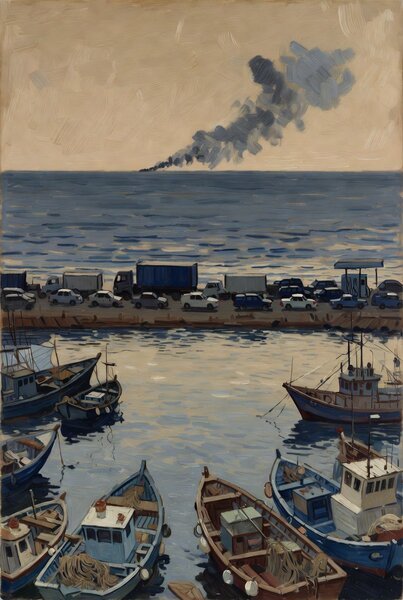
Station Eleven finds itself compiling a list. The Trembling Isles: reserves opened. The Thousand Islands: coal plants fired up. The Southern Reach: standards lowered. The Far Isles: cash distributed. The Vine Republics: steps taken. The Fog Isles: denial issued. The Low Dikes: fishermen remaining in port because the cost of diesel exceeds the value of the catch. None of these nations fired a missile. None of them drew a border through someone else’s territory. None of their leaders threatened to obliterate anyone’s power grid. Yet all of them — every single one — are rearranging their economies, revising their promises, and asking their inhabitants to accept less, because a war between three nations on the far side of a continent has disrupted the flow of the black liquid through the Narrow Passage. The inhabitants have built a civilisation that runs on a single substance extracted from a handful of locations, transported through a few chokepoints, and priced by collective anxiety. They are now learning what happens when one of those chokepoints becomes a war zone. The lesson is not complicated. The consequences are.
Meanwhile, on the northern edge of the Continental Pact, the inhabitants of the Frost Crown went to the polls. This is a small monarchy — a nation of islands and bridges, known for its bicycles and its restraint — and under normal circumstances, its elections would concern themselves with pensions and housing and the usual domestic negotiations. These are not normal circumstances. The Loud Commander of the Eagle Republic has declared his intention to acquire the Ice Shield — the vast, frozen territory in the far north that has been governed by the Frost Crown for centuries. The Commander has not explained precisely how he intends to acquire a landmass that belongs to another sovereign nation. He has simply stated his desire, repeatedly, with the confidence of someone who has never been told no. The Frost Crown’s inhabitants went to vote in a state of anxious determination, their election transformed from a domestic exercise into a referendum on sovereignty itself. When a superpower’s leader announces that he wants your territory, the question on the ballot ceases to be “which party shall govern” and becomes “shall we be governed at all.”
In the southern reaches of the western continent, a military transport aircraft carrying one hundred and twenty-one people crashed in the jungle of the Green Canyons. Sixty-six inhabitants died. Survivors were pulled from the wreckage by rescue teams who cut through the canopy to reach them. In any other week, this would have been the day’s leading story across the Signal Web — a catastrophe of the kind that stops the scroll, that makes the inhabitants pause and reckon with the fragility of flight. This week, it was a paragraph between fuel reports. The war has consumed the world’s attention so completely that sixty-six people falling from the sky into the Amazon barely interrupted the news cycle’s rotation. Station Eleven recorded the number. Someone should.
Twenty-six days. The Flame Lands have not accepted the Commander’s terms. The Commander’s five-day reprieve, announced yesterday, has changed nothing except the mood in the Counting Houses — which rallied, briefly, on the promise of a pause that the Flame Lands say does not exist. The missiles continue. The oil continues to flow, or not flow, through the Narrow Passage. And in harbours and petrol stations and government offices across a dozen nations that have nothing to do with this war, the inhabitants are discovering what Station Eleven has long suspected: that on a connected planet, there are no bystanders. There are only participants who have not yet received their invoice.
-- Monitoring Station Eleven, 2026.083