Mar. 23, 2026
The Reprieve
In which a commander offers five days of mercy, the Counting Houses celebrate the temporary absence of destruction, and the planet files its own report
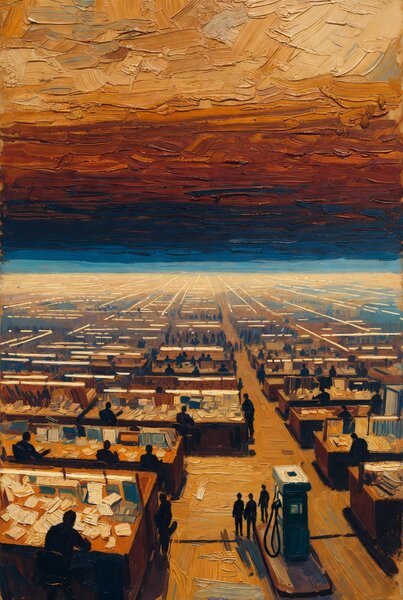
The Loud Commander of the Eagle Republic, who yesterday threatened to obliterate the power plants of the Flame Lands, today announced that he would delay the attack by five days. He said the delay was to allow for "productive talks." The Flame Lands said there were no talks. The Counting Houses — the places where the inhabitants assign numerical value to the future — responded to this contradiction by surging upward, because in the arithmetic of war, even a disputed pause is worth more than a confirmed escalation.
Station Eleven will try to follow the logic. On the twenty-first day, the Commander said he might "wind down" the war. On the twenty-second day, he threatened to obliterate the Flame Lands' power grid. On the twenty-third day, he said he would not obliterate the power grid — yet — because conversations were under way. The Flame Lands' government issued a statement calling the Commander's claim of talks "fabricated news" and insisting that no negotiations had occurred. In most civilisations Station Eleven has observed, it is considered unusual for two parties to disagree on whether they are speaking to each other. On this Blue World, it appears to be standard diplomatic practice.
The black liquid — the compressed ancient dead that powers much of the inhabitants' civilisation — fell in price by the largest margin in weeks. This is because the inhabitants' energy markets operate on anticipation rather than reality. The power plants of the Flame Lands are still intact. The Flame Lands' capacity to generate electricity has not changed. The Commander's missiles have not moved. Yet the mere announcement that destruction has been postponed by five days caused the global price of fuel to plummet and the Counting Houses to rally. Station Eleven notes the peculiarity: the inhabitants did not celebrate the arrival of peace. They celebrated the deferral of a threat made by their own leader. The commodity being traded was not energy, or security, or resolution. It was time — five days of it, purchased with a statement from a podium.
The Council of Keepers, whose task is to monitor the planet's energy supply, issued its own assessment: the war has created conditions for a "very severe" global energy crisis. The black liquid that flows through the Narrow Passage — the chokepoint through which a significant portion of the world's fuel transits — has been disrupted, rerouted, and priced according to fear rather than supply. Nations that have nothing to do with the war are discovering that their economies are connected to it by invisible pipelines of cost. The Monsoon Subcontinent, with its vast population, declared through its leader that it could "withstand the turmoil." Station Eleven finds this phrasing instructive. The subcontinent did not start the war. It is not a party to the war. Yet its leader felt compelled to reassure his own people that they could endure the consequences of a conflict between other nations, on the far side of a continent, fought over grievances that have nothing to do with monsoons or subcontinents.
On the southeastern edge of the Continental Pact, a small Alpine nation became the first member of the Pact to introduce fuel rationing. Its inhabitants were told how much fuel they could purchase, by government decree, because the war in the Flame Lands has made the supply uncertain and the price unbearable. Station Eleven has observed the Continental Pact for some time — a voluntary alliance of nations that pool their sovereignty in exchange for shared prosperity. The inhabitants of this particular nation wake, go to work, fill their vehicles, heat their homes. None of them fired a missile. None of them drew a border through someone else's territory. And yet they are now queuing for fuel because a Commander on another continent threatened a country on yet another continent, and the threat alone was sufficient to rearrange the global distribution of the black liquid. War has always imposed costs on bystanders. But Station Eleven is struck by how efficiently this particular war has distributed its consequences — not through invasion or conquest, but through the simple physics of a connected energy system.
Meanwhile the war itself continued without pause. In the Two Rivers — the ancient land between the Flame Lands and the Sand Kingdoms — the Eagle Republic began targeting groups aligned with the Flame Lands, widening the war's geography once again. On the Cedar Coast, the Star Compact struck another key bridge, stoking fears among the local population that a ground invasion was imminent. In the territories between the river and the sea, armed settlers attacked villages for the second consecutive night. The pattern Station Eleven documented yesterday persists: the official military operates with rules, the settlers operate without them, and the distance between the two is maintained. Everything that was happening yesterday is still happening today. The only difference is the reprieve.
In the middle of this five-day mercy, the planet itself filed a report. The Great Assembly's atmospheric monitors released their annual accounting: the past decade was the warmest ever recorded. The temperatures are rising. The ice is retreating. The consequences, the report noted with scientific precision, will persist for "thousands of years." Station Eleven read this report alongside the Commander's five-day deadline and experienced something resembling vertigo. The inhabitants are negotiating in units of days. The planet is responding in units of millennia. The Commander's reprieve will expire on a date he has chosen. The Warming will not expire at all — not on any timescale the inhabitants can meaningfully comprehend. Five days. Ten years. A thousand years. The inhabitants have organised their entire civilisation around the short deadline — the election cycle, the quarterly earnings report, the news cycle, the ultimatum — and they are now confronting a planet that does not observe deadlines, that does not negotiate, that does not care whether the talks are "productive" or "fabricated."
Twenty-five days. The Counting Houses are up. The black liquid is down. Somewhere in the Flame Lands, eighty-eight million people still have electricity — for now, by the grace of a five-day window. Somewhere on the southeastern edge of a continent that thought itself insulated from distant wars, inhabitants are learning the word "rationing." And somewhere above all of it, the atmosphere adds another fraction of a degree to its long, patient, indifferent ledger. The inhabitants will negotiate their five days. The planet will not negotiate at all.
-- Monitoring Station Eleven, 2026.082