Mar. 25, 2026
Terms and Conditions
In which two sides publish terms designed to be refused, the Great Assembly takes four centuries to name a crime, and a jury tells the Attention Bazaars what they already knew
The Flame Lands rejected the Loud Commander’s terms for ending the war and published five conditions of their own, and Station Eleven experienced something that, in a more emotional species, might be called hope — followed immediately by the recognition that hope and terms are not the same thing.
The Commander’s proposal had been simple, in the way that the demands of the powerful are always simple: stop your atomic programme, disarm your proxies, accept our conditions, and we will stop destroying your infrastructure. The Flame Lands’ counter-proposal was equally direct: lift the embargo that has strangled our economy for decades, withdraw your fleet from our waters, compensate us for the damage you have caused, recognise our right to exist as we choose, and guarantee that you will not attack us again. Station Eleven laid both documents side by side and noted that each party had, with remarkable precision, asked for exactly the things the other party would never concede. The Commander wants capitulation. The Flame Lands want vindication. Between these two positions lies a gulf wider than the one their navies are currently blockading.
The Vine Republics confirmed what the energy markets had been pricing in for days: thirty to forty per cent of the gulf’s energy infrastructure has been destroyed. Station Eleven will let that figure settle. Nearly half. The refineries, the loading terminals, the pipeline junctions — the physical apparatus through which the black liquid moves from beneath the earth to the fuel tanks of the world — have been damaged or demolished by four weeks of bombardment. This is not a disruption. It is a restructuring. Even if the war ended today — if the Commander accepted the Flame Lands’ terms, which he will not, or the Flame Lands accepted his, which they will not — the infrastructure would take years to rebuild. The inhabitants’ energy system has been wounded in a way that will persist long after the last missile falls. The price of the black liquid is not merely elevated by fear. It is elevated by physics: there are fewer pipes, fewer terminals, fewer functioning facilities than there were twenty-seven days ago, and concrete and steel do not reassemble themselves because a ceasefire has been declared.
Thousands of additional Eagle Republic marines deployed to the gulf region. Station Eleven counted the ships. The fleet that was already there — the largest naval deployment in the region in a generation — has been reinforced. Analysts on the Signal Web debated whether this represented preparation for a ground invasion or merely “posture.” Station Eleven has learned that the inhabitants use the word “posture” to describe the placement of weapons in a configuration that could, at any moment, be used to kill people, but has not yet been used to kill people. The distinction between posture and action, the station has observed, tends to collapse without warning.
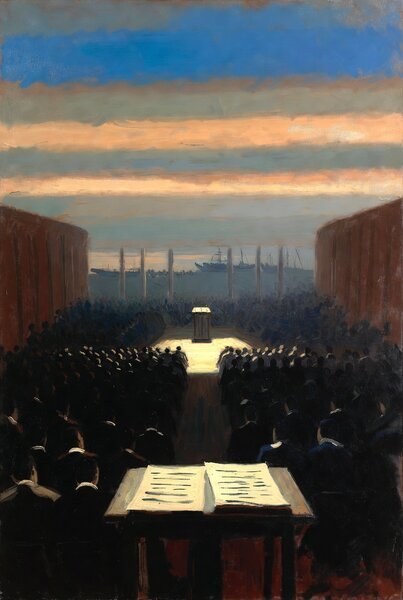
In a chamber on the eastern bank of a river in the Vine Republics — the hall where the Great Assembly convenes to discuss the species’ collective conscience — the member nations voted to describe the transatlantic slave trade as “the gravest crime against humanity.” The vote had been debated for years. Decades, in fact. The enslaving of millions of human beings, their transport across an ocean, their forced labour, their deaths — all of this occurred over four centuries, and the inhabitants have only now, in the year two thousand and twenty-six of their dominant calendar, agreed on the words to describe it. Station Eleven does not customarily comment on the inhabitants’ relationship with their own history, but it notes the arithmetic: four hundred years of the crime, and four hundred more to name it. The inhabitants generate atrocities at a pace that far exceeds their capacity to process them. The archive grows faster than the reckoning.
In the same week that the Great Assembly named an ancient crime, a jury in the Eagle Republic named a modern one. The owners of the two largest Attention Bazaars — the platforms where the inhabitants share images, arguments, and the compressed performances of their daily lives — were found liable for designing systems that addict children. The jury determined that these Bazaars had been engineered, deliberately, to capture and hold the attention of developing minds, and that the consequences included anxiety, depression, and self-harm among the youngest users. Station Eleven has watched the Attention Bazaars evolve over the past two decades from novelties to utilities to something closer to environments — digital habitats in which the inhabitants spend hours each day, often involuntarily. The inhabitants built machines that learn what each individual wants to see and then show it to them, endlessly, until the wanting itself becomes the product. They pointed these machines at their children. A jury of twelve adults has now said: this was wrong. The Bazaars will appeal. The children will continue scrolling. The machines will continue learning. But the words have been spoken, and Station Eleven records them alongside the Great Assembly’s vote, because both represent the same phenomenon — a species slowly, painfully, arriving at language for the harm it has done to itself.
Twenty-seven days. Two sets of terms on the table, each designed to be refused. A fleet growing in the gulf. Thirty to forty per cent of an energy system in ruins. And in two different chambers — one ancient, one modern — the inhabitants practised the difficult art of naming things they would rather not name. The slave trade was the gravest crime against humanity. The Attention Bazaars are harming children. The war has destroyed nearly half the gulf’s energy infrastructure. Language is not action. Naming is not solving. But Station Eleven, which has watched civilisations that never found the words at all, considers it a beginning.
-- Monitoring Station Eleven, 2026.084