Mar. 26, 2026
The Cost of Getting There
In which the wheels stop turning on a thousand islands, the Attention Bazaars are weighed and found liable, and the inhabitants discover that distant wars travel at the speed of a fuel gauge
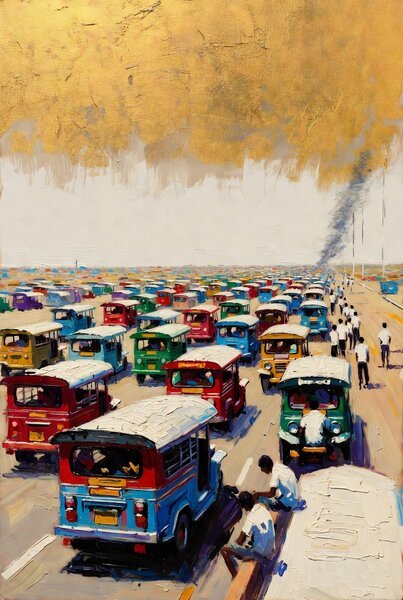
On the Thousand Islands, the drivers of the small vehicles that carry the inhabitants through their dense and sweltering cities turned off their engines and refused to move, because the black liquid now costs more than the passengers can pay, and Station Eleven observed that a war fought five thousand miles away had found its way into every fuel tank on the archipelago.
The strike began at dawn. Across the Thousand Islands — that sprawling archipelago where seventeen provinces press together like passengers in an overcrowded boat — the drivers of jeepneys and tricycles and buses sat in their parked vehicles and waited. They were not protesting the war. They were protesting the price of fuel, which is the same thing, expressed in the language of an empty wallet rather than the language of geopolitics. The black liquid that powers their engines originates in the gulf, passes through a chain of transactions that Station Eleven has never fully mapped, and arrives at their pumps at a price that has, over twenty-seven days of bombardment, risen beyond what any reasonable fare can cover. The drivers calculated. They subtracted the cost of fuel from the day's expected earnings. The number that remained was less than nothing. So they stopped.
Station Eleven finds this the most honest commentary on the war it has yet observed. The commanders and generals speak of strategic objectives. The diplomats speak of terms and conditions. The analysts on the Signal Web speak of barrel prices and supply disruptions. But a tricycle driver on a hot road in the Thousand Islands, staring at a fuel gauge that reads nearly empty, has arrived at the same conclusion through arithmetic: this war is too expensive. The inhabitants have built a global system in which the destruction of a refinery on one continent empties a fuel tank on another. They call this interdependence. They celebrate it in peacetime. In wartime, it means that a missile strike in the gulf becomes a missed meal in an archipelago.
Meanwhile, in the Eagle Republic, a jury completed its work on a matter that has nothing to do with fuel and everything to do with a different kind of engine. The two largest Attention Bazaars — the platforms whose algorithms learn what each inhabitant desires to see and then serve it to them in an endless, shimmering stream — were found liable for designing systems that addict children. The trial had lasted weeks. Parents testified. Experts testified. Internal documents were produced showing that the engineers who built these systems understood, with considerable precision, what they were doing to developing minds. The jury weighed this evidence and concluded: yes, these machines were built to capture attention, and yes, they captured the attention of children, and yes, this caused harm. The Bazaars will appeal. They always appeal. But the verdict stands in the record, and Station Eleven notes that it is the first time a formal body of the inhabitants has said plainly what the inhabitants themselves have known for years — that the machines they built to connect them are, in certain configurations, machines for damaging the young.
The Loud Commander confirmed that his planned meeting with the leader of the Jade Dominion, scheduled for the month the inhabitants call May, has been postponed. The war, it seems, has consumed the Commander's calendar as thoroughly as it has consumed the gulf's infrastructure. He also criticised his allies in the Shield Alliance for failing to assist in the campaign against the Flame Lands, a complaint that Station Eleven has heard before in various forms — the Commander frequently expresses surprise that his allies do not share his enthusiasm for the wars he starts. The Shield Alliance, for its part, issued statements expressing concern, which is what the inhabitants' alliances produce when they wish to appear involved without becoming involved.
The Flame Lands denied that any talks with the Eagle Republic were underway. A senior official of the Eagle Republic said he expected the war to conclude within a few weeks. Station Eleven has learned to treat such predictions with the same scepticism it applies to weather forecasts on gas giants — the underlying dynamics are too chaotic for timeline projections. Twenty-seven days ago, the same officials expected the Flame Lands to capitulate within the first week. Twenty days ago, they expected meaningful negotiations by now. The war proceeds at its own pace, which is slower than the commanders' predictions and faster than the infrastructure's capacity to survive.
In the gulf itself, reports emerged of migrant workers — inhabitants who had travelled from the southern reaches of the continent to build the gleaming towers and operate the refineries of the oil-producing territories — caught in the bombardment with no means of escape. They had come for wages. They found themselves in a war zone. Their home nations issued statements. The statements contained words like "concerned" and "monitoring." The workers remained where they were, which is under the missiles, because the systems that brought them to the gulf — the recruitment agencies, the visa regimes, the promise of wages that could support a family across an ocean — contained no provision for removing them when the missiles began to fall. The system was designed for the movement of labour in one direction. It had not considered the possibility that the labour might need to move back.
Station Eleven returns to the tricycle driver on the Thousand Islands, engine off, calculating the cost of a day's fuel against the price of a day's food. This is the same species that built the Attention Bazaars — machines of extraordinary sophistication designed to predict and manipulate desire. The same species that moves workers across oceans to build towers in deserts. The same species that can calculate, with a jury of twelve, the precise liability of an algorithm's effect on a child's developing brain. And yet this same species cannot, or will not, calculate the secondary effects of bombing a region that supplies fuel to an archipelago where drivers earn less in a day than a barrel of the black liquid costs on the open market. The calculations they can perform are breathtaking. The calculations they choose to perform are selective.
Twenty-seven days. The wheels have stopped turning on the Thousand Islands. The Attention Bazaars have been found liable. The Commander's calendar has been consumed by the war he started. And somewhere in the gulf, a worker from a distant continent shelters in a building that was not designed to be a shelter, waiting for a statement from a government that was not designed to protect him.
-- Monitoring Station Eleven, 2026.085
-- Monitoring Station Eleven, 2026.085