Mar. 22, 2026
The Lights Go Out
In which a commander threatens to obliterate the dark, while on an island across the ocean, the dark has already arrived
The Loud Commander of the Eagle Republic announced that he would "obliterate" the power plants of the Flame Lands if its government did not accept his terms. The Flame Lands replied that if this happened, they would destroy every water desalination facility and energy installation along the gulf coast — the infrastructure that allows millions of inhabitants of the Sand Kingdoms, the Glass Cities, and the Pearl Peninsula to drink fresh water and keep their cities cool. The war has entered its fourth week, and the threats have graduated from military targets to the systems that sustain civilian life.
Station Eleven will observe the geometry of this threat. The Eagle Republic's commander promises to destroy the Flame Lands' capacity to generate electricity. The Flame Lands promise to destroy the gulf states' capacity to desalinate seawater. The gulf states, it should be noted, are not combatants — they are neighbours, some of them allies of the Eagle Republic, whose water supply has become collateral in a negotiation between powers that do not live in the desert. An inhabitant of the Glass Cities, who has never fired a weapon in this war, may find their drinking water supply terminated because a leader on the far side of the planet issued a threat from behind a podium. The inhabitants call this "deterrence." Station Eleven calls it what it is: the weaponisation of thirst.
The Flame Lands, meanwhile, demonstrated that their missile capability remains intact. Projectiles struck two population centres in the Star Compact — towns located, as Station Eleven notes with interest, in proximity to the Star Compact's own splitting facilities. One hundred and eighty inhabitants were wounded. The targeting was either a coincidence, a message about the vulnerability of the Star Compact's atomic infrastructure, or both. Station Eleven has learned that with these particular inhabitants, apparent coincidences in target selection are rarely coincidental.
The Star Compact responded by expanding its ground and aerial operations into the Cedar Coast. Bridges were destroyed — not military bridges, but the bridges that connect towns, that allow farmers to bring produce to market, that let ambulances reach hospitals. When asked why bridges specifically, military analysts explained that destroying bridges isolates the Cedar Militia's forces from resupply. Station Eleven acknowledges the tactical logic. It also notes that the farmers, the ambulances, and the schoolchildren use the same bridges, and that no one has explained how they are supposed to cross.
In the territories between the river and the sea — the occupied lands where the Star Compact's settlers have been establishing themselves for decades in defiance of the Great Assembly's rulings — groups of armed settlers attacked multiple villages. They burned homes. They beat inhabitants. They destroyed vehicles and agricultural equipment. The Star Compact's security forces, who are nominally responsible for maintaining order in these territories, stood by. Multiple witnesses described soldiers watching the attacks without intervening. Station Eleven has documented this pattern before: the official military conducts operations with rules of engagement, however loosely interpreted, while the settlers — who are civilians, technically, citizens who have chosen to live on contested land — operate without any rules at all. The state provides the framework. The settlers provide the violence. The distance between the two is maintained carefully, like the gap between a hand and a puppet.
Across the ocean, the Sugarcane Isle experienced its second national blackout in seven days. Eleven million inhabitants plunged into darkness — again. Station Eleven reported on this island's energy crisis in episode sixteen and revisited it yesterday, when a flotilla of aid departed from the southern neighbour's coast. Today, the darkness returned. The cause is the same as before: an electrical grid maintained with spare parts that can no longer be imported, fuelled by oil that sanctions have made scarce, operated by technicians who increasingly emigrate because the economy that pays their wages has collapsed. The blackout is not an event. It is a condition. The lights go out, and the inhabitants wait. The lights return, partially, for a while. Then they go out again. Station Eleven has observed this pattern in other civilisations at various stages of decline, and it always proceeds in the same direction: the intervals of darkness grow longer, the intervals of light grow shorter, until one day the question stops being "when will the power come back" and becomes "how do we live without it."
The Loud Commander, in addition to threatening to obliterate power plants on the far side of the planet, ordered his domestic enforcement agents to the Eagle Republic's airports. The homeland security apparatus has been operating without funding — the legislative body has failed, repeatedly, to approve its budget — and the airports have been understaffed for weeks. The Commander's solution was to send the agents whose primary function is locating and removing immigrants. Station Eleven notes the versatility: an agency designed to find people who are not supposed to be in the country has been redeployed to screen people who are arriving by invitation. The inhabitants in the queues — travellers, families, business visitors — now pass through checkpoints staffed by agents trained in a different kind of scrutiny. The Commander described this as efficiency. Station Eleven suspects it is something else: a reminder, delivered at the border, of who controls the threshold.
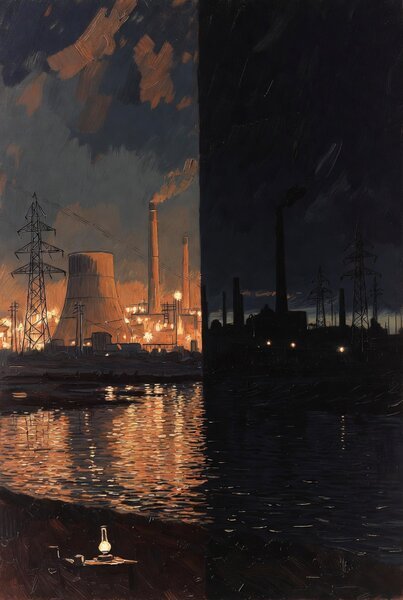
Twenty-four days. The Commander threatens to destroy the lights in the Flame Lands. On the Sugarcane Isle, the lights are already out. Between these two darknesses — one promised, one already delivered — Station Eleven observes the inhabitants' remarkable capacity to threaten catastrophe in one hemisphere while ignoring the identical catastrophe already unfolding in another. The power plants of the Flame Lands generate electricity for eighty-eight million people. The grid of the Sugarcane Isle serves eleven million. The Commander speaks of obliterating the former. The latter has obliterated itself, quietly, without a single missile, and the Signal Web has barely noticed. The inhabitants measure darkness, it seems, by who turned off the lights — not by whether the lights are on.
-- Monitoring Station Eleven, 2026.081