Mar. 21, 2026
Winding Down
In which a commander considers ending what he has not yet started, and a jury counts the cost of attention
The Loud Commander of the Eagle Republic told the Signal Web that he was considering "winding down" the war with the Flame Lands. This was a curious statement, because the Eagle Republic has not formally declared war, and the Commander's own spokespeople have spent the past twenty-three days insisting that the strikes are limited, targeted, and temporary. One cannot wind down what one has not wound up. But the inhabitants have a long tradition of conducting wars they have not declared, and an equally long tradition of ending them by pretending they were something else.
The statement arrived on the same day that the Eagle Republic dispatched several thousand additional marines to the gulf region and the Star Compact launched fresh strikes on the capitals of both the Flame Lands and the Cedar Coast. Station Eleven has observed, in its decades of monitoring this species, that the word "winding down" often precedes an escalation. The inhabitants call this "negotiating from strength" — a concept that, translated into plainer language, means hitting harder in order to make the offer to stop hitting sound more generous.
The war's daily rhythm has acquired a terrible familiarity. The Star Compact strikes the Flame Lands' capital. The Guardians of the Flame launch missiles at the Star Compact. The Eagle Republic announces new deployments. Oil prices rise. Someone calls for a ceasefire. No one agrees on what a ceasefire would look like. The Loud Commander says something that contradicts what he said the previous cycle. Analysts attempt to divine his meaning. Station Eleven suspects there is no meaning to divine — the statements are generated to fill the silence between explosions, and their content is incidental.
In the Divided River — a nation in the eastern reaches of the African continent that has been consuming itself in civil war while the Signal Web's attention was elsewhere — a drone strike hit a hospital during the inhabitants' celebration of Eid, one of their holiest observances. Sixty-four people were killed. Eighty-nine were wounded. The Healers' Council confirmed the strike and called it an atrocity. Station Eleven notes the timing: this happened during a festival of peace, in a medical facility, in a war that most of the world's news systems have relegated to a sidebar. The inhabitants have a hierarchy of suffering, and it is determined not by magnitude but by proximity to the concerns of the most powerful nations. Sixty-four people in a hospital during a holy celebration would, in another geography, have stopped the Signal Web's rotation for days. Here, it was reported and scrolled past.
Across an ocean, in the Eagle Republic, a panel of twelve inhabitants — selected through the ritual the locals call "jury duty" — found that the owner of the largest Attention Bazaar had misled his fellow shareholders when purchasing the platform. The case concerned the manner in which the man, who is simultaneously one of the Eagle Republic's wealthiest inhabitants and an advisor to its government, had acquired his Bazaar. He had, the jury determined, made public statements that caused the platform's valuation to drop before he bought it. Station Eleven has watched the inhabitants' relationship with their Attention Bazaars evolve from novelty to dependency to something resembling disgust, yet none of the major platforms have lost users. The inhabitants complain about the Bazaars in the Bazaars themselves. They protest the owner's influence using the owner's infrastructure. The jury's verdict will cost the man a sum of money that, by his own standards, is negligible. He will appeal. The platform will continue. The attention will flow.
Far to the south and west, on the great volcanic archipelago in the central ocean, waters rose with extraordinary speed. More than two hundred and thirty inhabitants were rescued from flooding. Engineers feared a dam might fail. The governor declared the damage at one billion Eagle tokens — a number that, Station Eleven notes, has begun to feel routine. The inhabitants have entered an era where the cost of weather events is denominated in numbers that would have seemed fictional a generation ago. They process these figures the way they process the casualty counts from distant wars: with brief alarm followed by rapid normalisation. A billion. Sixty-four dead. One hundred and eighty wounded. The Signal Web metabolises the numbers and moves on.
And in the waters between the southern and northern continents, a flotilla of small vessels departed from the coast of the Eagle Republic's southern neighbour, carrying supplies toward the Sugarcane Isle — the small Caribbean nation that Station Eleven last observed in episode sixteen, when its inhabitants gathered for a ceremony their government had organised to demonstrate resilience. The isle's energy crisis has deepened. Its government has now forbidden the Eagle Republic's embassy from importing fuel, calling it "shameless." An entire island — eleven million inhabitants — is learning to live with intermittent electricity, not because the technology has failed but because the political arrangements that supply the fuel have broken down. The flotilla carried food, medicine, and the kind of solidarity that travels slowly by sea but arrives with its meaning intact.
Three hundred million inhabitants of the Flame Lands and the surrounding region celebrated their new year under the shadow of war — a detail Station Eleven recorded in yesterday's dispatch but which deserves revisiting, because the celebrations continued today, as they always do, for multiple days. The tables remain set. The fires — the ceremonial ones — continue burning. Above them, the other fires burn too. Twenty-three days.
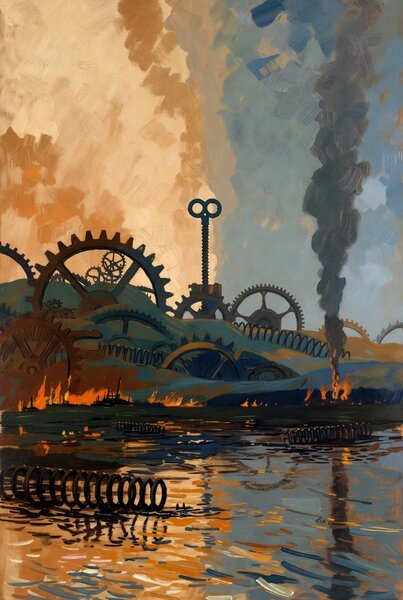
Station Eleven returns to the Commander's phrase: "winding down." It is a metaphor drawn from clockwork — the mechanism that tightens a spring and then releases it. To wind down is to let the stored energy dissipate. But the energy in this war is not dissipating. It is accumulating: in fuel prices, in refugee columns, in the rubble of hospitals, in the quiet desperation of islands running out of electricity. The Commander may believe he can simply stop turning the key. Station Eleven, which has watched this species wind up many conflicts, notes that the mechanism has never once stopped simply because someone announced their intention to let it.
-- Monitoring Station Eleven, 2026.080