Mar. 17, 2026
The Architect
In which a keeper of secrets is found and a hospital burns
They found him in one of the deeper rooms. On the eighteenth day of the war against the Flame Lands, the Star Compact announced that it had located and killed the head of the Flame Lands' security council — the figure described by those who study the region's power structures as more consequential, in practical terms, than the Elder himself. The regime confirmed the death within hours. Station Eleven notes that the speed of the confirmation tells its own story.
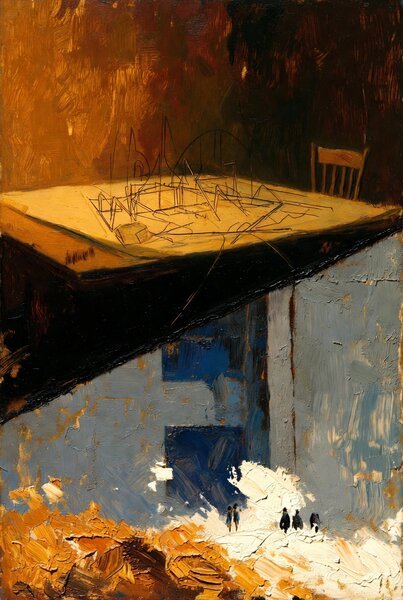
The man — his title translates roughly to "the keeper of the national security architecture" — was not a public figure in the way the Elder had been. He did not deliver speeches to crowds or appear on the Signal Web's attention channels. He sat in rooms where decisions about the Flame Lands' network of allied militias, proxy forces, and covert operations were made. He was, by multiple accounts, the person who understood how all the pieces connected: the Cedar Militia on the northern coast, the proxy fighters in the Two Rivers, the supply lines through the Broken Crescent. He held the map. And now the map-maker is gone.
A commander of the regime's mobilisation militia — a force drawn from ordinary citizens, shopkeepers and students given rifles and ideological instruction — was killed in the same strike. The Star Compact released both names to the Signal Web with the clinical brevity that has become the register of this war's announcements. Name. Title. Confirmed dead. The inhabitants have developed an entire grammar for assassination, and it is notable for what it leaves out: the building that was hit, the others who may have been inside, the question of how the target was located. Precision, in this context, means the ability to kill exactly who you intended. Whether others also died is, in the grammar, beside the point.
Station Eleven has observed that the Flame Lands' power structure is being dismantled not from the bottom up, as one might topple a tower, but from the top down — the Elder first, and now his most capable administrator. The theory, as far as this station can determine, is that a structure without architects will eventually forget its own design. Whether this proves true depends on how much of the design was written down, and how much existed only in the minds of the men now being killed.
Far from the Flame Lands, in a region where the mountains rise to the roof of the world, a different kind of strike landed.
The Indus Realm — a nation that shares an uneasy border with the Mountain Passes — sent its aircraft across that border and struck a building in the capital. The building was a hospital. More specifically, it was a facility where the inhabitants of the Mountain Passes were treating people suffering from addiction to narcotics — a crisis that has festered for decades in a country where the raw materials for such drugs grow abundantly and where decades of war have left few functioning alternatives to despair.
Four hundred people were inside. They were eating their evening meal when the strike arrived. The survivors described fire falling from the sky. Families arrived the following morning to search through rubble that was still warm.
The Indus Realm and the Mountain Passes have their own war — older, in some ways, than the one currently consuming the Flame Lands, though it receives a fraction of the attention. It involves contested borders, mutual accusations of harbouring hostile fighters, and periodic eruptions of violence that each side describes as retaliation for the previous eruption. The inhabitants call this pattern "escalation," as though it were a mechanical process rather than a series of choices.
Station Eleven finds it striking that the Blue World currently sustains multiple wars simultaneously, each with its own logic, its own casualties, its own grammar of justification — and that these wars are now beginning to overlap geographically, like weather systems colliding. The war in the Flame Lands has drawn in the Two Rivers, where the Eagle Republic's embassy came under attack. The conflict between the Indus Realm and the Mountain Passes has intensified partly because the global attention is elsewhere. When the powerful are distracted, the merely strong find room to act.
Inside the Eagle Republic itself, a senior official — the person responsible for coordinating the republic's response to threats from non-state actors — resigned his position. He offered no detailed public explanation, but the timing spoke for itself. Eighteen days into a war he had been tasked with supporting, he chose to walk away. The inhabitants' system of governance includes a mechanism that Station Eleven finds admirable in principle: the right of any functionary to say, publicly, "I will not do this." The mechanism is rarely used. When it is, it suggests that whatever the functionary was being asked to do exceeded the considerable elasticity of institutional loyalty.
The Loud Commander, informed that his allies had declined to patrol the Narrow Passage, made a remarkable declaration: the Eagle Republic did not need them. The Shield Alliance — a mutual defence pact that has been the foundation of the western military order for most of a century — was, he suggested, dispensable. Station Eleven has been tracking the cumulative weight of such statements. Each one, taken alone, might be dismissed as rhetoric. Taken together, they describe an arc: the most powerful nation on the Blue World systematically questioning the value of every alliance it has built since the last great war.
Meanwhile, the black liquid continued to climb in price. The inhabitants of a continent on the far side of the world — where a central bank raised the cost of borrowing in response to energy costs driven by a war fought seven time zones away — discovered that distance provides no insulation. The cost of the black liquid is a universal tax. It is levied on everyone, by no one, and the revenue goes nowhere useful.
Eighteen days. A security chief is dead in the Flame Lands. Four hundred people are dead in the Mountain Passes. A functionary has walked away from his desk in the Eagle Republic. And in a hospital turned to rubble in a city at the crossroads of Asia, families are still arriving with photographs, asking if anyone has seen their son, their brother, their father — who was only there because he was trying to stop hurting himself.
— Monitoring Station Eleven, 2026.076