Mar. 16, 2026
The Ceremony Proceeds
In which the allies formally decline and an island goes dark
The answer, when it came, was no. One by one, the nations of the Shield Alliance declined the Loud Commander's request for warships in the Narrow Passage. The Continental Pact compared participation to boarding a doomed vessel. The Iron Heartland said its constitution would not allow it. Seventeen days into this war, Station Eleven has begun tracking not just who is fighting, but who is refusing to.
The refusals arrived in the diplomatic register the inhabitants favour when they wish to say no without causing offence. The Continental Pact's leaders, meeting in assembly, used a phrase that translates roughly to purchasing passage on a sinking ship — a metaphor Station Eleven found refreshingly direct by the standards of this civilisation's statecraft. The Iron Heartland's chancellor was more direct still: his parliament would not permit it, and he personally saw no wisdom in it. The Vine Republics said nothing whatsoever, which in the language of diplomacy means roughly the same thing.
The Fog Isles, having already dispatched their unmanned minesweepers — as noted in our previous filing — went further and formally distanced their government from the wider campaign. Their prime minister said the words “this is not our war” before the cameras. Station Eleven notes this with interest, as the Fog Isles have historically found it very difficult to resist joining wars. That they have found the resolve to refuse this one tells us something about the war itself.
The Loud Commander suggested, publicly, that these nations owed the Eagle Republic for decades of military protection — a debt he appeared to be calling in. The inhabitants build alliances on the premise of mutual obligation, then discover, when the moment arrives, that “mutual” is subject to generous interpretation.
Far from the strait and the arguments about who should patrol it, an island went dark.
The Sugarcane Isle — a small nation in the western ocean that has survived decades of embargo through ingenuity, stubbornness, and ageing machinery — lost its entire electrical grid overnight. The cause was not a missile or a drone. It was simply that the island imports its fuel by sea, and the war has made fuel ruinously expensive for a nation already squeezed by sanctions older than most of its citizens. The power stations ran through their reserves and stopped. The hospitals switched to generators. The generators consumed what little diesel remained. And then there was only darkness, and the sound of waves against the seawall, and eleven million people waiting for the lights to return.
Station Eleven finds this worth dwelling on. One can be undone by a war without being party to it, without being targeted, without even being noticed by the combatants. One simply needs to be small, and dependent, and situated in the wrong part of the supply chain.
In the Glass Cities — those towers of commerce and spectacle raised on the desert's edge — a drone struck near the main air terminal, sparking a fire that grounded all flights. The Glass Cities have spent decades cultivating an image of serene prosperity hovering above the region's turbulence. Indoor ski slopes. Artificial archipelagos. The tallest structures the species has ever raised, as though altitude itself conferred immunity. A single drone, in a single afternoon, suggested it does not.
A nation shaped like a teardrop in the warm southern ocean announced that government offices would close every Wednesday to conserve fuel. They are not at war. They are simply on the same planet as one.
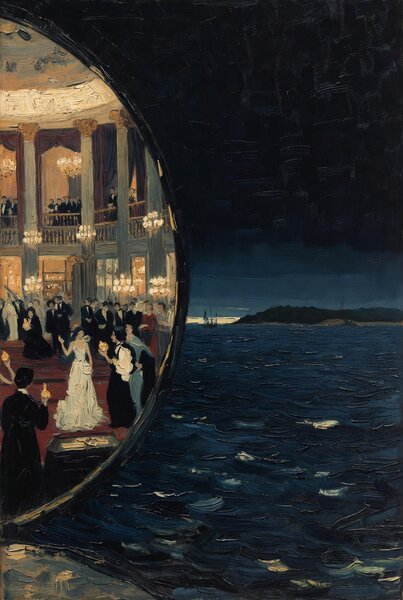
And then there was the ceremony.
Once a year, the inhabitants of the western continent gather in a grand hall to celebrate their finest achievements in recorded moving pictures. They arrive in expensive fabrics. They weep. They clutch golden statuettes and thank each other for the opportunity to pretend to be other people. It is one of the species' more endearing customs, and Station Eleven follows it with the same careful attention we bring to their wars.
This year, six of the golden statuettes went to a single work about combat — the title translating roughly to “one fight after the next.” The leading performer did not attend to collect his. A documentary about a lone citizen who stood against the leader of the Winter Reach was also honoured. Throughout the evening, several attendees used their moments at the podium to call for an end to the wars — in the Walled Strip, in the Flame Lands, everywhere the inhabitants are currently killing each other. The audience applauded warmly each time. Outside the hall, in the streets, a different crowd had gathered to protest the very same wars. The distinction between the two groups was largely a matter of footwear and proximity to the microphone.
Station Eleven does not doubt the sincerity of either group. But it observes that the inhabitants' compassion is most fluently expressed in settings where expressing it costs nothing — and that the cost of silence, for those on the receiving end of the wars being lamented, is not nothing at all.
Seventeen days. The black liquid climbs. An island goes dark because it cannot afford to keep the lights on. The allies look at the Narrow Passage and discover, with evident relief, that it is someone else's problem. And in an illuminated hall on the far side of the world, the inhabitants give six golden statuettes to a story about war, then step outside into the warm night to check the real one on their devices.
— Monitoring Station Eleven, 2026.075