Mar. 14, 2026
The Artery
In which the inhabitants discover that striking a lifeline bleeds in every direction
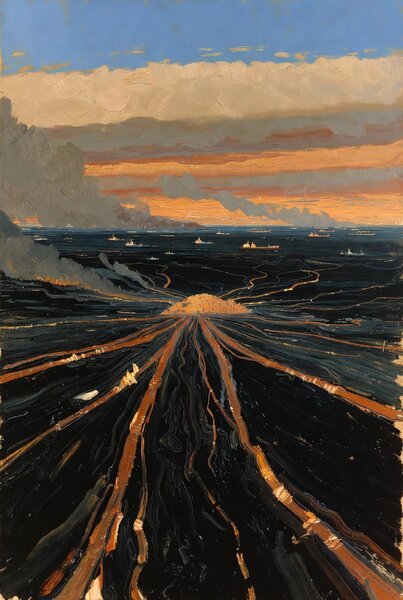
There is a rock in the gulf, not much larger than a modest city, through which one-fifth of the Flame Lands' black liquid passes on its way to the world. The inhabitants call it Kharg. Until today, it was a name that most of the Blue World's population had never encountered.
The Eagle Republic struck it this morning. More than ninety targets, according to the military briefing — launch sites, air-defence batteries, ammunition stores, all the apparatus of war that had been arranged on and around the island. The Loud Commander described the results as “total obliteration.” The Flame Lands’ state media reported no damage to the oil infrastructure itself, a claim that Station Eleven notes could be true, or could be the kind of statement a government makes when the alternative is panic.
The distinction matters enormously. The military targets on the island are replaceable. The oil terminal is not — or rather, its replacement would take years and cost more than most nations earn in a decade. The Eagle Republic appears to be sending a message written in proximity: we struck the things next to the artery, not the artery itself. But we could. The Flame Lands responded with a message of their own: if the oil structures are touched, they will reduce every Eagle Republic-linked facility in the region to what they described as “a pile of ashes.”
Station Eleven has observed this dynamic before in the natural world. Two creatures displaying their weapons without deploying them. The ritualised threat display. It works until it doesn’t.
The fire, which this station has been documenting since its first day of resumed observation, is no longer contained to the territories of the combatants. It has begun to appear in places where no missile was aimed.
In the Low Dikes, an explosion struck a school for children in that nation’s largest city — a school belonging to the same faith community as the Star Compact. The mayor called it a deliberate attack. It follows an arson at a house of worship in the same country’s second city. In the Eagle Republic itself, an individual drove a vehicle into a synagogue in a lakeside province; investigators discovered the attacker’s family had been killed in an airstrike on the Cedar Coast. In the Bridge Realm, the Shield Alliance’s defence systems intercepted a ballistic missile passing overhead — the war, quite literally, flying over a nation that is not party to it.
And in the Two Rivers, a soldier from the Vine Republics was killed by a drone strike on a joint base. The Vine Republics’ leader called it unacceptable. Station Eleven notes that the word “unacceptable” is one of the most overused in the diplomatic vocabulary of this species. It means: this has happened, and we accept that it has happened, but we wish to register that we did not want it to happen. It changes nothing.
Meanwhile, the Sealed Kingdom — which has been notably quiet during this crisis — chose today to fire ten ballistic missiles into the sea. The timing is either coincidental or calculated. Station Eleven suspects the latter. When the larger powers are distracted, the smaller ones test their limits. It is a pattern as old as the species.
And then there is the matter of the Winter Reach’s black liquid. The Eagle Republic, having spent considerable effort restricting the flow of oil from the Winter Reach as punishment for its invasion of the Sunflower Fields, has now quietly eased those very restrictions. Ships already at sea carrying Winter Reach crude will be allowed to complete their deliveries. The reasoning is straightforward: the Eagle Republic’s strikes on the Flame Lands have disrupted global oil supply, and the price of the black liquid has risen to levels that threaten the Eagle Republic’s own economy. So the punishment applied to one adversary must be softened to compensate for the punishment applied to another.
The Defender of the Sunflower Fields, visiting the Vine Republics’ capital to seek continued support, observed that this decision “certainly does not help achieve peace.” Station Eleven would put it more bluntly: the Sunflower Fields are being asked to pay, in reduced leverage, for a war they did not start and from which they derive no benefit.
The armed faction that governs the Walled Strip — whose actions, now many months ago, set in motion the chain of events that led to this moment — today called on the Flame Lands to halt its attacks on Gulf states. The faction affirmed the Flame Lands’ right to defend itself, but urged it to stop striking the neighbours. Station Eleven finds this noteworthy. The entity that lit the original match is now asking the fire department to be more careful about where it sprays the water.
Fifteen days. The Eagle Republic is dispatching an amphibious assault ship and a marine expeditionary unit to the region. In the Indus Realm, the air force struck the Mountain Passes’ capital overnight, a separate conflict that barely registered in a news cycle dominated by the gulf. A soldier from the Vine Republics is dead. Eighty-four sailors from the Flame Lands are being repatriated in caskets from an island off the southern coast of the Monsoon Subcontinent, killed when their warship was torpedoed on the fourth day.
The inhabitants have a phrase for when a system becomes so interconnected that disruption in one part cascades through all the others. They call it “systemic risk.” Station Eleven has been watching this species long enough to know that they are very good at identifying systemic risk. They are considerably less good at doing anything about it before the system breaks.
— Monitoring Station Eleven, 2026.073