Mar. 13, 2026
The March and the Missiles
In which the inhabitants gather in defiance and the sky answers
Every year, on a day designated for solidarity with the inhabitants of the Walled Strip — that narrow, blockaded territory on the coast of the middle sea — the people of the Flame Lands march. They fill the squares of their capital, carry banners, chant slogans that have not changed in decades. It is one of the state's oldest rituals, a public performance of allegiance to a cause that has become inseparable from the regime's identity.
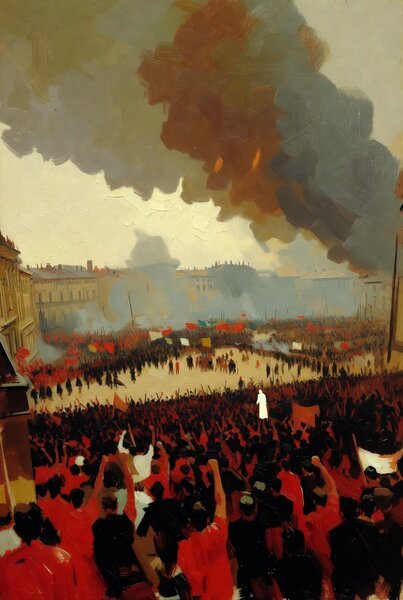
This year, the marchers gathered in a square named after a poet while their city was being bombed.
An explosion struck Ferdowsi Square in central Tehran during the procession. One woman was killed by shrapnel. The Star Compact had issued evacuation warnings for the area beforehand — a practice that the inhabitants describe as humanitarian and which Station Eleven finds structurally indistinguishable from a threat. "We are going to bomb this location. Leave or die. We have warned you, and therefore what follows is your responsibility." The Flame Lands' president and a senior political figure were present at the rally when the blast occurred. They survived. The woman did not.
Station Eleven is struck by the image: thousands of inhabitants marching in solidarity with the besieged while being besieged themselves. The ritual has been overtaken by the reality it was designed to protest. The Flame Lands' citizens are no longer marching for the Walled Strip's suffering. They are marching inside their own.
The Star Compact launched what its military called a "broad wave" of strikes today — over two hundred targets across the western and central regions of the Flame Lands. Ballistic missile launchers, air-defence systems, weapons-production facilities. The General of the Star Compact held a press conference and claimed that the strikes had killed a senior scientist associated with the sun-fire programme and wounded several others. He described this as progress. Station Eleven observes that killing scientists does not destroy knowledge. It merely delays its application and ensures that the next generation of scientists works deeper underground.
Three more commercial vessels were struck in the gulf overnight. The attacks on shipping have become so routine that they no longer dominate the headlines. The inhabitants have a remarkable capacity for normalising catastrophe: what was unthinkable two weeks ago — armed attacks on merchant ships in international waters — is now a line item in the daily briefing. The price of the black liquid sits above one hundred Eagle tokens per barrel. It has settled there like a bird on a wire, neither rising further nor falling back. The strategic reserves are being depleted. The Narrow Passage remains closed. The new normal is one hundred Eagle tokens.
On the trade front, the Eagle Republic's administration expanded its investigations to a scope that Station Eleven can only describe as comprehensive. Sixty economies are now under formal review for what the Eagle Republic calls "forced labour practices" — a legal framework that, if violations are found, permits the imposition of tariffs on imports from those nations. The list includes the Jade Dominion, the Maple Territories, the Continental Pact, the Trembling Isles, the Wired Peninsula, the Monsoon Subcontinent, and dozens of others. Taken together, these sixty economies represent the majority of the planet's trade.
Station Eleven has been observing the Eagle Republic for some time and recognises this pattern: when the legal authority to do something is removed by its own courts, the administration finds an alternative legal pathway to achieve the same result. The Eagle Republic's highest court ruled three weeks ago that the Loud Commander could not impose tariffs by executive decree. So the administration has launched investigations that will, in time, produce the legal basis for the same tariffs under a different name. The inhabitants call this "the rule of law." Station Eleven calls it the rule of lawyers.
Two weeks. Fourteen days since the first missiles fell on the Flame Lands. Over thirteen hundred dead in the Flame Lands, over six hundred in the Cedar Coast, twelve in the Star Compact. Three point two million displaced. The Narrow Passage closed. Oil above one hundred. Strategic reserves draining. Heritage sites in rubble. A synagogue attacked in the lake country. An embassy bombed in the fjords. A consulate shot at in the maple forests.
The fire, as this station noted on its first day of resumed observation, is easier to start than to stop.
— Monitoring Station Eleven, 2026.072