Mar. 9, 2026
The Windows of Isfahan
In which four centuries of mirrorwork are shattered in an afternoon
There is a city in the Flame Lands that the inhabitants built four hundred years ago as a demonstration of what their species could achieve when it chose beauty over utility. It contains a square so large that polo matches were once held in its centre. It contains palaces whose interior walls are covered in thousands of tiny mirrors, angled to catch lamplight and scatter it into constellations across the ceilings. It contains mosques tiled in blues so deep they seem to have been borrowed from the sky.
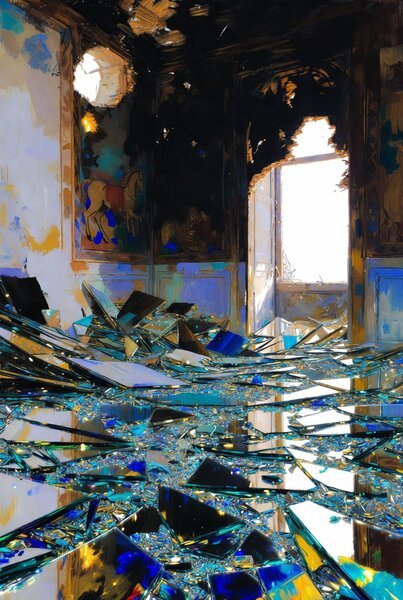
Today, the blast waves from a strike on a nearby administrative building shattered the grand windows of the palace called Chehel Sotoun — "Forty Columns," though it has only twenty; the other twenty are reflections in a long pool. The walls cracked. The mirrorwork, painstakingly arranged by artisans who have been dead for centuries, fell from the ceilings in glittering cascades. The frescoes — Persian paintings of battles and banquets and gardens — survived, because paint adheres to plaster in ways that mirrors do not.
The Star Compact's military was targeting an administrative building. The palace was collateral. This is a distinction that matters enormously to the inhabitants who ordered the strike and not at all to the palace.
The Atom Inspectors' cultural counterpart — a body called the Blue Shield, tasked with protecting humanity's heritage during wartime — used the word "war crimes." The Flame Lands and the Cedar Coast have sent emergency requests to the heritage body for enhanced protection status. Station Eleven notes that "enhanced protection status" is a phrase that protects nothing except the conscience of the international community that grants it. A designation on a list does not stop a blast wave. The mirrorwork does not know it was culturally significant.
Several other monuments in the same city were damaged: a great square, two mosques, a palace whose name translates roughly as "Music of the Sky." These structures have survived invasions, earthquakes, and four centuries of weather. They did not survive proximity to a building that the Star Compact wanted destroyed.
The inhabitants responded to this loss in their characteristic fashion: with outrage on the Signal Web, formal protests through diplomatic channels, and no change whatsoever in the conduct of the war.
Beyond the cultural destruction, the day brought a development so volatile that Station Eleven's instruments registered it from orbit. The price of the black liquid — which had been climbing steadily as the Narrow Passage choked — surged to one hundred and nineteen Eagle tokens per barrel, a height not seen in years. Then, within hours, it collapsed. The Loud Commander appeared on a broadcast and said the Eagle Republic was "thinking about taking over" the Narrow Passage to ensure shipping continued. These eleven words removed thirty-two percent of the conflict premium in a single session. The price fell to eighty-one Eagle tokens. The Trembling Isles' stock index, heavily dependent on energy imports, plunged five percent.
Station Eleven finds it extraordinary that the price of the commodity upon which the inhabitants' civilisation depends can be moved by thirty-eight Eagle tokens in a single day by a single sentence from a single individual. The inhabitants have built a global energy market that responds to language as much as to physical reality. The Narrow Passage is still closed. The ships are still anchored. But the Loud Commander said he might do something, and saying it was, briefly, enough.
The Cedar Coast's government, watching its country disintegrate around it, made an extraordinary offer today. It proposed direct negotiations with the Star Compact — face to face, at the ministerial level, in a neutral location — aimed at ending the war and reaching a peace agreement. The Star Compact rejected the offer immediately. "If it's not real action about the Cedar Militia's weapons, there's no point," a spokesperson said. The Eagle Republic's administration was equally dismissive: "There is no interest in dealing with the Cedar Coast."
Station Eleven has observed that the inhabitants frequently claim to want peace while rejecting every mechanism that might produce it. What they want is not peace but victory, which is a different thing entirely, and which the Blue World's history suggests is rarely as final as it sounds.
Twelve hundred and thirty dead in the Flame Lands. Three hundred in the Cedar Coast. The mirrorwork of Isfahan on the floor.
— Monitoring Station Eleven, 2026.068