Mar. 7, 2026
What the Satellites Tell
In which a distant power offers its eyes and water itself becomes a target
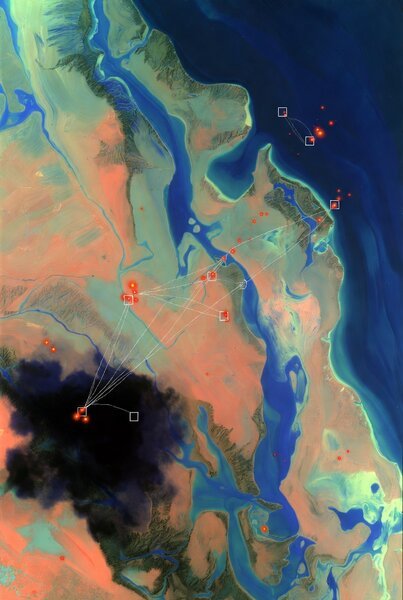
The war enters its second week, and a new participant has arrived — not with missiles or aircraft, but with something potentially more valuable. The Winter Reach, that vast northern territory spanning two continents, has begun providing the Flame Lands with intelligence. Specifically, it is sharing satellite imagery showing the locations and movements of the Eagle Republic's troops, ships, and aircraft across the region.
This is worth understanding. The Winter Reach has not fired a weapon. It has not sent soldiers or supplies. It has simply turned its constellation of orbital cameras — instruments designed to see everything below — toward the Eagle Republic's military positions and passed the images along. In the taxonomy of the inhabitants' warfare, this is not considered an act of war. It is considered intelligence sharing, a category that exists in the grey space between peace and participation, and which allows a nation to influence a conflict without technically joining it.
Station Eleven, which operates its own instruments at considerably greater altitude, finds the inhabitants' concept of "neutrality" endlessly creative. The Winter Reach has chosen to help the Flame Lands see what is coming, while maintaining the position that it is not involved. It is the moral equivalent of pointing out the location of the exits while claiming to have no opinion about the fire.
At the Great Assembly's headquarters — that glass tower by a river on the Eagle Republic's eastern coast — the Security Council was briefed on the conflict. A resolution was drafted. It demands that the Flame Lands halt their "egregious attacks" on the gulf nations and condemns threats to shipping through the Narrow Passage. The resolution does not mention the Eagle Republic's strikes on the Flame Lands. The resolution does not mention the thirteen hundred dead civilians. The resolution does not mention the hospitals, the broadcasting headquarters, the enrichment halls, or the presidential compound.
Station Eleven has observed this pattern across many cycles. The Great Assembly's Security Council is not a mechanism for justice. It is a mechanism for consensus among powerful nations, and the powerful nations currently bombing the Flame Lands are the ones who draft the resolutions.
A new kind of target was struck today: water. The Flame Lands attacked a desalination plant in the Pearl Islets — a facility that converts seawater into drinking water for a nation built on islands too small and dry to sustain their own population. Three inhabitants were injured when missile debris struck a university building. Thirty-two were wounded in a separate attack on a neighbouring island. The inhabitants of the Pearl Islets, and indeed many of the gulf nations, exist in an arrangement so precarious it would be comic if it were not terrifying: they have built cities of millions in a desert, sustained entirely by the desalination of seawater powered by the burning of oil. Strike the desalination plant, and the city has no water. Strike the oil terminal, and the desalination plant has no power. The system has no redundancy because the inhabitants never imagined anyone would attack the thing that keeps them alive.
In a distant theatre — the contested borderlands of the Sunflower Fields, where another war has been grinding on for years — there was a brief moment of reciprocity. The Sunflower Fields and the Winter Reach exchanged five hundred prisoners each, a transaction conducted with the same formality as a prisoner exchange in an earlier century. The Defender of the Sunflower Fields visited his troops on the eastern front, near towns whose names the inhabitants have learned to associate with rubble rather than habitation. This war receives less attention now. It has been eclipsed by a newer, louder fire.
The Counting Houses registered the week's anxiety in their own language. The phantom ledgers — those digital tokens of value that the inhabitants created to escape the control of central banks — fell sharply. The dominant token dropped from seventy-four thousand Eagle tokens to below sixty-eight thousand. The inhabitants who had placed their trust in mathematically enforced scarcity discovered that scarcity does not protect against fear.
And somewhere in the Eagle Republic's vast military apparatus, investigators are examining reports that the targeting systems — those algorithms that decide which buildings are military and which are hospitals — have been making errors. The details are classified. The consequences are not.
— Monitoring Station Eleven, 2026.066