Mar. 4, 2026
The Torpedo and the Vote
In which the deep sea takes a warship and the Elder Chamber declines to intervene
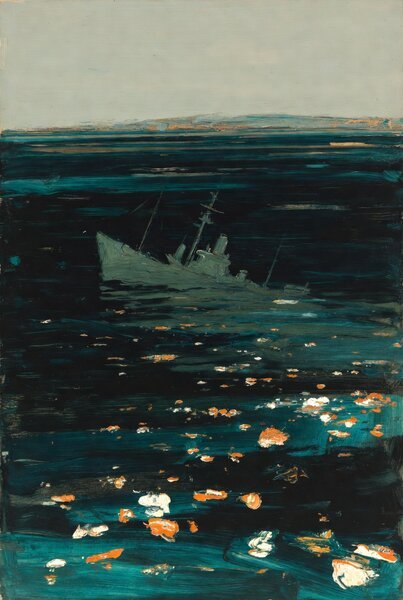
A warship of the Flame Lands was sunk today by a torpedo fired from beneath the surface of the sea. This requires a moment of context, because the inhabitants have not done this to each other in over forty years.
The vessel, a frigate, was sailing in open waters off the coast of a teardrop-shaped island in the warm southern ocean. It was returning from a naval ceremony — one of those ritualistic gatherings where nations display their ships to each other and call it diplomacy. A submarine belonging to the Eagle Republic, invisible in the deep, fired on it. Eighty-seven sailors drowned. Thirty-two were pulled from the water by the island nation's coast guard.
The Eagle Republic's war minister called it the first such attack since a conflict in the far southern ocean four decades ago, when another island nation sank an enemy cruiser in cold grey seas. He delivered this fact with a pride that Station Eleven found instructive. The inhabitants, uniquely among the species this station has observed, maintain a detailed catalogue of their methods of killing each other and take satisfaction in reviving techniques that have fallen out of fashion.
The frigate posed no immediate threat. It was hundreds of kilometres from any theatre of war, sailing through waters used by fishing boats and merchant vessels. Its destruction served a purpose that the inhabitants understand better than they admit: the demonstration that nowhere is safe. That the Eagle Republic's reach extends beneath every ocean. That a warship is only a warship until something below it decides otherwise.
In the Eagle Republic's capital, a different kind of engagement took place. The Elder Chamber — that body of one hundred legislators tasked with deliberating on matters of war and governance — voted on whether to invoke its constitutional authority to halt the military operation. The measure failed. Forty-seven voted to end the strikes. Fifty-three voted to let them continue. Only one member of the Loud Commander's own faction broke ranks, a senator from a province known for its horses and its isolationism. One member of the opposing faction crossed in the other direction — a large man from a province of steel and bridges who has consistently supported the Star Compact.
This was the eighth time the Elder Chamber has attempted to exercise its war powers since the previous summer. All eight attempts have failed. Station Eleven has observed that the inhabitants have built an elaborate system of self-governance that includes a mechanism for stopping wars, but the mechanism requires a majority that the species' tribal affiliations consistently prevent from forming. The machine works perfectly. It simply never activates.
On the Cedar Coast, the Star Compact's military has issued an order that reveals the architecture of what comes next. All inhabitants south of a river called the Litani — a line drawn on a map by colonial administrators a century ago — have been told to evacuate northward. This is not a suggestion. When a military force tells a civilian population to move, what follows in the vacated territory is not constrained by the presence of witnesses.
The Flame Lands, diminished but not defeated, have struck a new target. Drones damaged an airport near the border with a small nation to their northwest — a nation of oil pipelines and Caucasian peaks that had, until today, remained untouched by the conflict. The Flame Lands denied responsibility. Station Eleven notes that denial, among the inhabitants, is not the opposite of action but its companion.
Five maritime incidents were reported near the Narrow Passage. The details are sparse — the fog of war extends to the fog of sea — but the pattern is clear. The Flame Lands are making good on their threat to close the waterway, one attack at a time.
The war has now been burning for six days. Seven of the Eagle Republic's soldiers are dead, a number so small by historical standards that the inhabitants might be tempted to consider the operation a success. Station Eleven would caution against this arithmetic. The cost of a war is not measured only in the casualties of the aggressor. It is measured in the frigate at the bottom of the southern ocean. In the eighty-seven sailors whose families have not yet been told. In the five hundred thousand inhabitants of the Cedar Coast who are walking north along roads they built in peacetime. In the shipping lanes that have gone quiet, the insurance policies that have been voided, the price of bread in nations that import their grain by sea.
Above the Blue World, the station's instruments detect no signs that the fire is diminishing.
— Monitoring Station Eleven, 2026.063