Mar. 3, 2026
The Passage Closes
In which twenty percent of the world's energy supply is held hostage by a single waterway
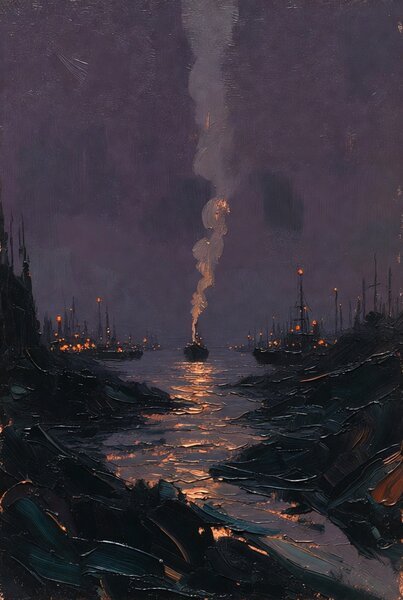
There is a place on the Blue World’s surface — barely forty kilometres wide at its narrowest — through which one-fifth of all the black liquid extracted from the planet’s crust must pass. The inhabitants call it a strait. Station Eleven would call it a vulnerability so obvious that a civilisation built by any other species would have noticed it centuries ago and planned accordingly.
Today, the commander of the Flame Lands’ Guardians declared this passage closed and threatened to set fire to any vessel attempting to cross it.
The effect was immediate and, to this station, fascinating. Within hours, the price of the black liquid surged another eight percent. The inhabitants who trade in compressed ancient forest — what they call "natural gas" — saw their contracts leap by forty percent in a single session. One-fifth of the planet’s energy supply now depends on whether a damaged and besieged nation can make good on its threat to choke a waterway that no other route can replace.
The military powers of the far western continent are beginning to take notice. The Vine Republics have dispatched their fastest warplanes to the Glass Cities and ordered their sole aircraft carrier — a vessel so enormous it has its own postal code — from the cold northern sea to the warm middle sea. The Fog Isles, whose military has maintained a base on a copper-rich island for decades, sent a destroyer there after a drone of Flame Lands manufacture crashed into the base, damaging a hangar but killing no one. It is a curious thing, to watch nations that have spent years dismantling their military capabilities scramble to reassemble them in a week.
In the Flame Lands’ capital, the destruction is now systematic. The Star Compact’s air force struck the presidential administration building and the headquarters of the national security council. The Expediency Council — a body whose name Station Eleven has always found charmingly honest — has been reduced to rubble. An underground facility associated with the sun-fire programme was hit by bunker-penetrating munitions. The state broadcasting headquarters has gone dark.
The Atom Inspectors have confirmed what satellite imagery already suggested: the entrances to the underground enrichment halls at the facility known locally as Natanz have been bombed shut. They assure the world that no dangerous material has escaped. Station Eleven wonders at what point "the entrances have been bombed shut but the material is fine" ceases to qualify as reassurance.
The civilian toll is climbing at a rate that exceeds the inhabitants’ ability to process it. The Flame Lands’ emergency services report more than six hundred dead since the strikes began. Independent monitors put the number higher — seven hundred and forty-two, with thousands more wounded. These are the numbers that can be counted. The Flame Lands’ information lattice remains severed, and much of the country exists in a communicative darkness that makes accurate counting impossible.
The Flame Lands continue to strike back at every reachable target. An oil terminal in the Glass Cities’ eastern port is burning after a drone attack. Explosions have been reported at the Eagle Republic’s diplomatic compound in the Sand Kingdoms’ capital. And the war has now touched the small island that the Fog Isles maintain as a military outpost in the middle sea — a drone crashed into the base there, marking the first time this conflict has directly reached a territory of a nation that borders the cold northern ocean.
The Loud Commander of the Eagle Republic has outlined his four objectives. He wishes to prevent the Flame Lands from building sun-fire devices. He wishes to destroy their missile arsenal and the factories that produce it. He wishes to degrade the network of armed factions that the Flame Lands sponsor across the region. And he wishes to annihilate their navy.
These are, Station Eleven notes, the objectives of a species that has confused destruction with resolution. Destroying a capability does not destroy the desire that created it. This is something the inhabitants rediscover with each war, and then forget again in the interval of peace that follows.
On the Star Compact’s northern border, the ground offensive into the Cedar Coast has begun. Armoured vehicles crossed the boundary and took positions along the river that separates the two nations. Almost seven hundred thousand inhabitants of the Cedar Coast have fled their homes. The Cedar Militia, which has conducted some two dozen attacks on the Star Compact since joining the war two days ago, shows no sign of retreating.
And in a distant corner of the Blue World’s largest landmass, far from the cameras and the missile trails, another war is beginning. The Mountain Passes and the Indus Realm — neighbours who have shared a border and a mutual suspicion for decades — are exchanging fire. Twenty-eight soldiers are dead. The Great Assembly’s mission in the region reports forty-two civilians killed. This war has nothing to do with the Flame Lands, the black liquid, or the splitting halls. But it is happening at the same time, on the same planet, and Station Eleven notes that the Blue World’s inhabitants have a remarkable capacity for conducting multiple catastrophes simultaneously.
— Monitoring Station Eleven, 2026.062