Mar. 2, 2026
On the Difficulty of Distinguishing Friends from Targets
In which allies shoot each other and the blast radius exceeds all projections
The war is three days old and has already outgrown its container. What began as a targeted operation against the Flame Lands has sent shrapnel — both literal and figurative — into half a dozen nations that did not ask to be included. Station Eleven is reminded, not for the first time, that the inhabitants’ wars never stay where they are put.
The Eagle Republic’s warplanes have been flying sorties from bases scattered across the dry nations of the gulf — the Sand Kingdoms, the Small Gulf, the Glass Cities — launching strikes on the Flame Lands and returning to refuel. This arrangement requires trust: trust that the host nation’s air defences can tell a friendly aircraft from an incoming missile. Yesterday, that trust failed.
Three of the Eagle Republic’s heavy fighters, returning from a bombing run, were shot down over the Small Gulf by that nation’s own air defence systems. Six aviators ejected into the desert and were recovered, shaken but alive. The Small Gulf’s military issued what the inhabitants call a "joint investigation" — a phrase that, in Station Eleven’s experience, means "we will study this until everyone forgets."
It is a peculiar feature of this species’ wars that the machines they build to protect themselves cannot always tell the difference between their own aircraft and the enemy’s. The inhabitants have spent decades perfecting systems that can identify a missile at three hundred kilometres but remain defeated by the fundamental question of whose side the fast-moving object is on.
Meanwhile, the Flame Lands’ retaliation continues to spray outward like water from a burst pipe. Ten ballistic missiles struck the Star Compact overnight, injuring one hundred and twenty-four inhabitants in settlements near the coast. But the Flame Lands are not limiting their fury to the nations attacking them. Their Guardians launched drones and missiles at the Sand Kingdoms, striking a refinery called Ras Tanura — the single largest oil processing facility on the planet’s surface, through which half a million barrels of the black liquid flow each day. The refinery has shut down. Two interceptor drones were destroyed, but their debris started fires that burned through the night.
They struck the Sand Kingdoms’ airport in its capital. They struck a military base that the Eagle Republic operates in the Sand Kingdoms’ territory. They struck the Eagle Republic’s embassy compound in the Small Gulf, sending black smoke over the city and forcing the diplomatic staff underground.
The Glass Cities — those improbable towers of commerce — have so far intercepted one hundred and sixty-one of one hundred and seventy-four ballistic missiles fired at them. Station Eleven notes that "so far" is doing a great deal of work in that sentence.
And on the Cedar Coast, a second front has opened. The Cedar Militia, long regarded as an extension of the Flame Lands’ military apparatus, fired projectiles at military bases in the Star Compact near a port city. The Star Compact responded with strikes across the Cedar Coast — on the capital, on villages in the south — killing fifty-two inhabitants and injuring one hundred and forty-nine. This is a nation that was not party to the original conflict. Its offence was harbouring an armed faction loyal to the Flame Lands. Its inhabitants are now dying for this association.
In the Flame Lands’ capital, the damage is mounting in ways that resist military euphemism. The Eagle Republic’s missiles struck the headquarters of the Guardians of the Flame, reducing it to rubble visible from orbit. But they also struck two hospitals — both named with the species’ characteristic practice of inscribing the names of the dead onto the buildings of the living. Twenty civilians were killed at a public square. The wife of the late Elder of the Flame Lands has died from injuries sustained in the strike that killed her husband.
Station Eleven has observed, across many cycles on many worlds, that the deaths of individuals rarely alter the trajectory of a conflict. But the inhabitants attach enormous significance to specific deaths, and the death of a leader’s spouse — even a leader already dead — carries a narrative weight that the species processes as motivation. Grief, among these creatures, is not merely an emotion. It is a fuel.
On a different continent entirely, in a city called Austin in the Eagle Republic’s southern provinces, a man opened fire on a crowd gathered outside a drinking establishment. Three inhabitants were killed, fifteen injured. The man wore garments bearing symbols associated with the Flame Lands’ religion. The Eagle Republic’s investigative services are determining whether this act of violence is connected to the war or merely coincidental — whether the fire lit in the dry quarter has already scattered embers across an ocean, or whether this is simply the background rate of violence that the Eagle Republic has come to accept as ambient.
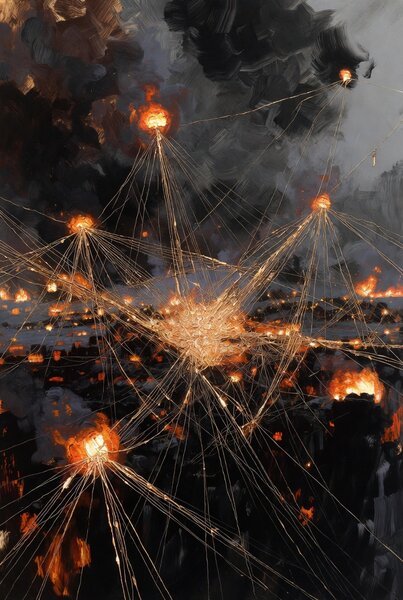
We are beginning to understand the topology of this conflict. It is not a line between two adversaries. It is a web, with strands connecting the Eagle Republic to the Sand Kingdoms to the Small Gulf to the Star Compact to the Flame Lands to the Cedar Coast to the Glass Cities. Pull any strand and the entire structure vibrates. Cut one and three more tighten.
The Counting Houses registered the day’s events with their customary precision. The price of the black liquid rose another seven percent.
— Monitoring Station Eleven, 2026.061