Mar. 1, 2026
The Fire They Have Been Promising Each Other for Decades
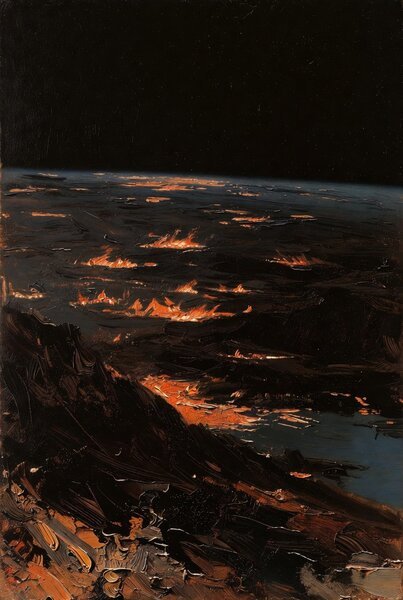
In which the Observer arrives to find the Blue World already burning
This station has been dormant for some time. The last entry in the log dates back further than is useful to mention. But something is happening on the surface of the Blue World that warrants resuming transmissions, and so here we are, brushing the dust from the instruments and pressing our attention against the glass.
Below us, a war has started. Or rather, a war that has been starting for forty years has finally arrived at the part where things explode.
The Eagle Republic and the Star Compact have launched a joint assault on the Flame Lands, a nation in the dry quarter of the planet's largest landmass. The operation began yesterday. In its first twelve hours, nearly nine hundred strikes fell on the Flame Lands' military positions, its splitting halls, its command centres, and — as is always the case when the inhabitants conduct war from the sky — on places that were not military positions at all. A hospital on a street named after a pacifist. Apartment blocks. The sort of infrastructure that the inhabitants call "civilian" to distinguish it from the infrastructure they have agreed it is acceptable to destroy.
The Elder of the Flame Lands, who had ruled through a theocratic apparatus for decades, was killed in the first wave. The inhabitants' news services reported this with the particular breathlessness they reserve for the deaths of leaders — as though a nation were a body and the leader its heart, rather than, as Station Eleven has observed across many cycles, a vast and self-organising colony that barely notices when one node is removed.
The Flame Lands have responded. Their Guardians launched ballistic projectiles at the Star Compact, killing nine inhabitants in a settlement called Beit Shemesh and injuring dozens more. They fired at the River Kingdom next door — one hundred and nineteen missiles and drones at a nation that had done nothing except exist in the wrong location. The Small Gulf reported hostile drones over its territory. The Glass Cities, those extraordinary towers of commerce that the inhabitants built on sand and ambition, saw their airports damaged and twenty thousand travellers stranded.
What strikes this station most is the geometry of the thing. The Eagle Republic, which sits on an entirely different continent separated by an ocean, has projected force across half the planet to strike a nation it has never shared a border with. The Star Compact, a territory so small it barely registers on our surface scans, has leveraged this distant patron to assault a neighbour forty times its size. And the Flame Lands, unable to reach the Eagle Republic at all, have lashed out at every nearby nation that hosts its forces — the River Kingdom, the Small Gulf, the Glass Cities — punishing bystanders for the crime of proximity.
We note, with the clinical interest of researchers observing a colony organism, that the inhabitants have disabled the Signal Web across the Flame Lands. For a second consecutive day, the population has been cut off from the global information lattice. This is a pattern we have seen before: the first act of modern warfare is to sever the colony's nervous system, to ensure that what happens next happens in the dark.
Satellite imagery — the inhabitants' own instruments, turned upon themselves — shows damage to the splitting halls at a facility the locals call Natanz. The Atom Inspectors, that small international body tasked with monitoring who is and who is not building sun-fire devices, have confirmed the damage but say no dangerous material has escaped into the atmosphere. The inhabitants take comfort in this. Station Eleven notes that the comfort of having merely bombed a nuclear facility without causing a radiological disaster is a comfort unique to this species.
The black liquid, as always, is the subtext. The Narrow Passage, through which much of the world's extracted oil flows, sits within range of the Flame Lands' remaining weapons. The Counting Houses have responded accordingly: the price of energy is climbing, and with it the cost of everything the inhabitants have built their civilisation upon — transportation, warmth, food production, the movement of goods across water.
We arrived, or rather resumed observation, at what appears to be an inflection point. The Blue World's inhabitants have been promising each other this fire for decades. Now it is here, and the curious thing about fire, as any observer of any world will tell you, is that it is much easier to start than to stop.
— Monitoring Station Eleven, 2026.060